
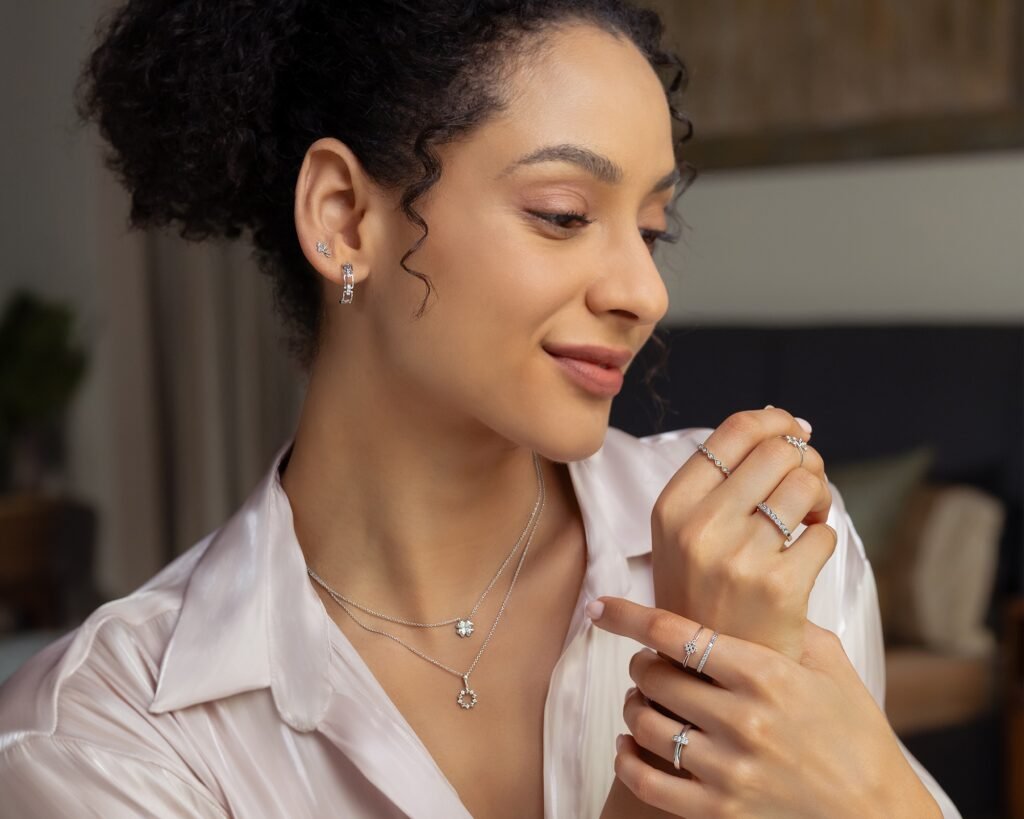
Diamond jewellery occupies a distinct position in the Indian market. It sits at the intersection of tradition and modernity, valued both as an aesthetic choice and as a store of wealth. For many families, buying a piece of diamond jewellery marks a significant milestone: a wedding, an anniversary, the birth of a child, or a professional achievement. Getting that purchase right requires a basic understanding of what determines a diamond’s quality and value.
This guide is not aimed at gemologists. It is aimed at the informed buyer who wants to walk into a jewellery showroom with enough knowledge to ask the right questions and make a confident decision. The good news is that the fundamentals are not complicated once you know where to focus.
The 4Cs: What They Actually Mean for the Buyer
The 4Cs, cut, colour, clarity, and carat weight, are the internationally recognised framework for evaluating diamonds. Each affects the stone’s visual quality and its price, though not equally.
Cut: The Most Important C
Cut refers to the proportions and angles of the facets, not the shape of the stone. A well-cut diamond reflects light from one facet to another and back through the top of the stone, creating the brilliance that makes a diamond visually arresting. A poorly cut diamond of excellent colour and clarity will look dull compared to a well-cut stone of lesser colour and clarity. For the buyer, cut quality should be the first priority, not the last.
Colour: Subtler Than You Think
Diamond colour is graded on a scale from D (completely colourless) to Z (light yellow). The difference between D and F is virtually invisible to the naked eye. For most buyers, stones in the G to I range offer excellent visual quality at a noticeably lower price than D to F stones. The colour difference only becomes perceptible when comparing stones side by side under controlled lighting, not in everyday wear.
Clarity: What Eye-Clean Really Means
Clarity refers to the presence of internal inclusions or surface blemishes. The scale runs from Flawless to Included. For the everyday buyer, an SI1 or SI2 stone is typically eye-clean, meaning inclusions are not visible without magnification. VS1 and VS2 stones are excellent choices for those who want additional assurance. Flawless and Internally Flawless grades carry a significant premium for a characteristic that makes no practical difference in wear.
Diamond Certification: Why It Matters
A diamond certificate, issued by an independent gemological laboratory, documents the stone’s 4C grades and confirms that the measurement was done by a third party rather than the seller. The most widely recognised certificates in India are from GIA (Gemological Institute of America) and IGI (International Gemological Institute).
For any diamond above 0.50 carats, insisting on a certificate is strongly advisable. It provides verifiable documentation for insurance purposes, makes the stone easier to sell or exchange in the future, and gives you confidence that the grade you paid for matches the stone you received. Reputable jewellers do not resist certification requests.
Diamond Styles for Different Occasions
Understanding the 4Cs helps you evaluate quality, but style selection is ultimately a matter of personal taste and intended use. Diamond jewellery in India spans an enormous range, from simple everyday pieces to elaborate occasion sets.
For daily wear, solitaire earrings and simple pendant designs are the most practical. They are lightweight, versatile, and require minimal maintenance. A well-chosen solitaire necklace or a pair of small diamond studs will coordinate with almost any outfit and transition between professional and social contexts without effort. The wide range of diamond jewellery collection available today includes both classic solitaire designs and more contemporary geometric styles.
Pendant Sets: The Versatile Middle Ground
Diamond pendant sets occupy a particularly useful position in the jewellery wardrobe. They are more substantial than a simple stud earring but less imposing than a full bridal set. They work for the office, for dinner, for festivals, and for semi-formal occasions. A well-chosen pendant set can serve as the centrepiece of an everyday jewellery look for years.
The key to choosing a pendant set that lasts is prioritising the pendant design itself over the size of the diamond. A beautifully designed pendant with a modest stone looks far more considered than an oversized stone in a mediocre setting. For those building their first significant diamond purchase, gold pendant sets with diamond accents offer a compelling middle ground between daily-wear simplicity and occasion-worthy elegance.
Diamond Rings: Navigating a Crowded Category
Diamond rings are perhaps the most emotionally loaded category in jewellery retail. The engagement ring tradition, which has become widespread in Indian urban markets, has expanded what buyers expect from diamond rings. Beyond the classic solitaire, pave-set bands, halo designs, and three-stone rings all have enthusiastic followings.
Practical considerations matter here as much as aesthetics. How does the ring wear day to day? Does the setting catch on clothing? Is the stone secure? A prong-set solitaire is classic but requires periodic inspection to ensure the prongs remain tight. A bezel-set diamond is more secure and lower maintenance, though it covers slightly more of the stone. For active wearers, the lower the profile of the setting, the more practical the ring.
Caring for Diamond Jewellery
Diamonds are the hardest natural material, but their settings are not. The gold or platinum holding the stone in place is susceptible to wear, particularly in prong settings. Having your diamond jewellery inspected annually by the jeweller, checking for loose prongs and worn settings, is a small but important step in protecting the investment.
Clean diamond jewellery at home with a soft toothbrush and warm soapy water. Avoid chemical cleaning agents near coloured stones. For professional ultrasonic cleaning, return to your jeweller who can assess whether the piece is suitable for that method.
Buying diamond jewellery is ultimately about knowing what you are looking for and finding it from a source you trust. The team at Waman Hari Pethe Sons brings more than a century of jewellery expertise to every consultation, and their diamond range covers everything from first purchases to significant occasion pieces.

 LOOK 01
 LOOK 02
 LOOK 03